Gun Control Will Not Stop Massacres
I heard of another massacre in the United States and calls for gun control. My immediate reflection was the children killed in Afghanistan and Iraq and the reality that there were few calls in the media to stop the murder of innocent people. We can look further around the world to Syria, to Egypt, Sudan, DR Congo, ethnic minorities and the list is endless. My mind wanders to the United Nations and a high proportion of member countries in the Security Council involved in the supply of guns (see Amnesty International http://www.amnesty.org/en/news/big-six-arms-exporters-2012-06-11)
The reality is that we live in a Culture of Violence worldwide which has been the result of centuries of war whereby power is extended through violence. That is, interests/individuals demand what they want through the force of violence. Why is violence used? It is used as it creates fear, it ensures the ‘other’ conforms to what is wanted or used as a channel to project negativity onto others. Projection of course concerns the negative beliefs that are unowned and then projected as blame onto others. This is evident when we see an enemy outside of ourselves, yet the negativity is within us but discounted or denied in favour of venting this rage on another. Violence can be subtle or overt through negativity vented as gossip, criticism, exclusion, jealousy, hatred, silence, domestic violence, community violence, mental illness, pain, tiredness, insecurity, lack of self esteem, frustration, stress, disconnection, isolation, neglect, inadequacy, inferiority, powerlessness, lack of self control, lack of empathy, child abuse, gangs, wars and so on. We are all familiar with the negative news in the media reinforcing the outcomes of states of fear and suppression, key ingredients in the creation of violence.
So what is violence? According to the free dictionary it is:
Violence in my experience has come from fear and beliefs of strength as power over others rather than power within. The fearful person pretends aggression to scare off the other, to ensure that the other remains scared of them. They feel a strong need to be in control as they feel out of control if they are not making sure everything is the way they want. It can be exacerbated by personalities that are perfectionists and have to have things their own way or they don’t cope. So they bully and coerce the other into submission. The other submits to ensure peace, which in reality is not peace but appeasement. I’ve understood violence manifest as a result of suppression of emotions and the eventual desire to explode with the full force of fury due to emotions bubbling underneath and requiring release. Violence emerges from the inability to access feelings, this is predominantly the case with males who are trained to suppress their feelings as they are seen as a weakness or vulnerability. This teaching is deeply dysfunctional.
I will post here information on what are emotions and how they are distorted. Neale Donald Walsch is an excellent source here. Neale is asking a question and source is answering, as follows:
… Five Natural Emotions. These are: grief, anger, envy, fear, and love. And within these, also, there are two final levels: love and fear.
While the five natural emotions include love and fear, these two are the basis of all emotions. The other three of the five natural emotions are outgrowths of these two.
Ultimately, all thoughts are sponsored by love or fear. This is the great polarity. This is the primal duality. Everything, ultimately, breaks down to one of these. All thoughts, ideas, concepts, understandings, decisions, choices, and actions are based in one of these. And, in the end, there is really only one. Love.
In truth, love is all there is. Even fear is an outgrowth of love, and when used effectively, expresses love. You may ask, “Fear expresses love?” And the answer is, in its highest form, yes. Everything expresses love, when the expression is in its highest form. Does the parent who saves the child from being killed in traffic express fear, or love? “Well, both, I suppose,” you might say. “Fear for the child s life, and love — enough to risk one s own life to save the child.” Precisely. And so here we see that fear in its highest form becomes love . . . is love . . . expressed as fear. Similarly, moving up the scale of natural emotions, grief, anger, and envy are all some form of fear, which, in turn, is some form of love.
One things leads to another. Do you see?
The problem comes in when any of the five natural emotions become distorted. Then they become grotesque, and not recognizable at all as outgrowths of love, much less as God, which is what Absolute Love is.
(Neale) I’ve heard of the five natural emotions before — from my wonderful association with Dr. Elisabeth Kuebler-Ross. She taught me about them.
Grief is a natural emotion. It’s that part of you which allows you to say goodbye when you don t want to say goodbye; to express — push out, propel — the sadness within you at the experience of any kind of loss. It could be the loss of a loved one, or the loss of a contact lens. When you are allowed to express your grief, you get rid of it. Children who are allowed to be sad when they are sad feel very healthy about sadness when they are adults, and therefore usually move through their sadness very quickly. Children who are told, “There, there, don’t cry”, have a hard time crying as adults. After all, they’ve been told all their life not to do that. So they repress their grief. Grief that is continually repressed becomes chronic depression, a very unnatural emotion. People have killed because of chronic depression. Wars have started, nations have fallen.
Anger is a natural emotion. It is the tool you have which allows you to say, “No, thank you.” It does not have to be abusive, and it never has to be damaging to another. When children are allowed to express their anger, they bring a very healthy attitude about it to their adult years, and therefore usually move through their anger very quickly. Children who are made to feel that their anger is not okay — that it is wrong to express it, and, in fact, that they shouldn’t even experience it — will have a difficult time appropriately dealing with their anger as adults. Anger that is continually repressed becomes rage, a very unnatural emotion. People have killed because of rage. Wars have started, nations have fallen.
Envy is a natural emotion. It is the emotion that makes a five-year-old wish he could reach the doorknob the way his sister can — or ride that bike. Envy is the natural emotion that makes you want to do it again; to try harder; to continue striving until you succeed. It is very healthy to be envious, very natural. When children are allowed to express their envy, they bring a very healthy attitude about it to their adult years, and therefore usually move through their envy very quickly. Children who are made to feel that envy is not okay — that it is wrong to express it, and, in fact, that they shouldn’t even experience it — will have a difficult time appropriately dealing with their envy as adults. Envy that is continually repressed becomes jealousy, a very unnatural emotion. People have killed because of jealousy. Wars have started, nations have fallen.
Fear is a natural emotion. All babies are born with only two fears: the fear of falling, and the fear of loud noises. All other fears are learned responses, brought to the child by its environment, taught to the child by its parents. The purpose of natural fear is to build in a bit of caution. Caution is a tool that helps keep the body alive. It is an outgrowth of love. Love of Self. Children who are made to feel that fear is not okay — that it is wrong to express it, and, in fact, that they shouldn’t even experience it — will have a difficult time appropriately dealing with their fear as adults. Fear that is continually repressed becomes panic, a very unnatural emotion. People have killed because of panic. Wars have started, nations have fallen.
Love is a natural emotion. When it is allowed to be expressed, and received, by a child, normally and naturally, without limitation or condition, inhibition or embarrassment, it does not require anything more. For the joy of love expressed and received in this way is sufficient unto itself. Yet love which has been conditioned, limited, warped by rules and regulations, rituals and restrictions, controlled, manipulated, and withheld, becomes unnatural. Children who are made to feel that their natural love is not okay — that it is wrong to express it, and, in fact, that they shouldn’t even experience it — will have a difficult time appropriately dealing with love as adults. Love that is continually repressed becomes possessiveness, a very unnatural emotion. People have killed because of possessiveness. Wars have started, nations have fallen.
And so it is that the natural emotions, when repressed, produce unnatural reactions and responses. And most natural emotions are repressed in most people. Yet these are your friends. These are your gifts. These are your divine tools, with which to craft your experience. You are given these tools at birth. They are to help you negotiate life.
Anger is a wonderful emotion, Beth! It lets us express — that is, push out — negative energy that has built up inside of us. It is not anger that is the problem, but how we express it; what we use it for. If we use it for damaging or hurting others, that expression would be non-beneficial (obviously). Yet if we use anger to alter a situation which is hurting ourselves or others, that would be extremely beneficial. So we see, then, that anger itself is not the issue, but rather, the way in which it is expressed and used. (http://www.cwg.org/bulletins/bulletin_488.html)
So the core problem in my perception is that violence is caused by suppression of our natural emotions.
Many are calling for gun control, is this the core problem? When I studied Peace Studies at La Trobe University (Australia) we discussed the concept of the gun in the hand of a perpetrator. In truth the gun is just a gun, an object that is safe until it is placed in the hands of a human being with negative or fearful intentions. Therefore, it is to look into the person who is holding the gun. Firstly why do people get guns? I think Michael Moore made it clear in his film Bowling for Columbine how Americans (Australians, Canadians, Iranians, Israeli’s, Palestinians, etc. etc.) feel fear and through this fear believe they perceive they need to be defended. This fear is in most cases not an actual attack but the perception of an attack (more powerful perception). Some call for their right to be armed rather than the right to resolve conflict and live in social harmony. You can see subtly the focus, one is on defence (attack) the other is on harmony (unity). If we drill down one is based on fear the other on love. Again, going further unquestioned fears arise where we see the other as the cause and we fight against them rather then seeking to resolve a matter through the desire for social harmony (love). The desire for peace and harmony moves us in the direction of solutions and hence living together in unity. We desire to look at ourselves honestly and listen to the other to use conflict as a means of learning about ourselves and others. I see the person I am in conflict with as my teacher and I look to see where I am uncomforable, what is unhealed in me. I remember my father used to say if I was yelling the loudest I must have the problem. I never believed that feeling outraged was my problem but today I see what that meant was feelings of insecurity, not good enough, inferiority, giving power away and so on. I realise today he had a point. He has also recently stated that saying nothing in his own life was his problem, he now believes in speaking up. Conflict resolution is excellent for really learning how to solve problems (not hating people) and in most cases realising what we believed was not true – as they say there are two sides to each story. So the notion of fear in all its shades (shadows) and love in all its colours (opportunities) lead to deeply different perspectives and different outcomes. One leads to a world living in fear and arming itself to the point where we will experience destruction. The other leads us down a road where we are not victims but the creator of our reality and we decide to create society in the image of harmony and unity. The latter leads to self understanding and happiness. In a practical sense a unity course would lead us down the path of peace education in the schools, conflict resolution, philosophy, problem solving, creative thinking (refer Edward de Bono and Sir Ken Robinson), artistic expression, emotional expression, applied wisdom, full human potential, real happiness and each taking responsibility for the shape of their world and impacts locally and globally.
Michael Moore in his film highlighted clearly how society was accepting violence as a fact of life and fear driving paranoia and distrust from local to international levels, I will highlight cases I found noteworthy. Moore demonstrated the acceptance of guns when he opened a bank account and was rewarded with a gun at a bank. There was humour in that banks tend to get robbed by men toting guns. So an irony there. He also took a Columbine student who had a bullet wound to K-Mart to ask for them not to stock bullets. Through his struggle to get a meeting with management he revealed the walls of management refusing to meet and address the issue. The stonewalling and avoidance only created a stronger desire for disclosure and fuelled anger rather than meeting in a space to resolve the problem and to learn from the outcome of the Columbine shooting and perhaps revisit their policy in terms of the types of products they stock. They could have viewed Michael Moore as an opportunity for corporate social responsibility (citizenship) rather than a threat to sales (private interests). It is important for commercial enterprises to assess if they are unwittingly contributing to a social ill e.g. part of the supply chain of providing the bullets used in a massacre. These are important questions and uncomfortable but they give rise to the perception of whether companies are part of the society or see themselves as private interests that are unaccountable to what happens when a product leaves their shop, in the case of bullets and crime rates and/or recreational shooting, how do they feel when they realise their product was used to shoot children. Perhaps looking at the high powered gun manufacturers, the military, the whole ethos of violence in the media and so on. All are interconnected, at what point is anyone accountable? It doesn’t mean the suppliers had conscious intent for violent outcomes of their products but there has to be an understanding that where we focus we create and to consider the question – does it serve society ultimately or are private interests the only concern? Are we as a society accountable in our silence (apathy) and demand (self interest)? The same questions can be raised with the supply of weapons to national conflicts by third parties, are they accountable under international laws? what about the ethical issues associated with the supply of uranium to countries with nuclear weapons e.g. Australia’s sales of uranium to India. To what extend do governments feel a sense of connectedness through supply to how these potentially dangerous resources are used, coal is another (climate change) and the list goes on. Essentially the point here is the ethics involved and the values of individuals and corporate entities creating a society that is the vision of peace and harmony or self interest and anything goes. Tonight I viewed a program on social enterprises which would be part of ethical trading. Social enterprises sell products or services for the social good, the profits go to unemployed disabled people, or helping those on drugs to get jobs or for other social good projects. I really liked the sound of that and I felt intuitively that is where we need to go as an evolved society, more into what we do benefits others. So these are important questions to ask rather than just say that is the way the world is. In reality we can change the world at any time, we just say no with our spending or communicate our opinions (democracy), only buy what is ethical and change the world through profits. These are all important questions and do drill down to whether we are responsible for what we see outside ourselves on some level. It can also be extrapolated to how we affect our neighbours or other society members, do we just do our own thing or consider how they feel? Or do we intevene when we are aware of violence nextdoor or say nothing – none of our business? In respect of Michael Moore’s film the most interesting linkage he provided was at the international level, the acceptance of violence in the name of national defence. He highlighted the activities of Lockheed Martin (based in the town of Columbine), quotes from the film (wikipedia) are as follows:
Lockheed Martin spokesperson Evan McCollum clarified that the plant no longer produces missiles (the plant manufactured parts for http://en.wikipedia.org/wiki/Intercontinental_ballistic_missile“>intercontinental ballistic missiles with a nuclear warhead in the mid-1980s), but rockets used for launching satellites:
I provided specific information to Moore about the space launch vehicles we build to launch spacecraft for NASA, NOAA, the Dept. of Defense and commercial customers, including DirecTV and EchoStar.[19]
Erik Möller argues that Moore’s question was not limited to the Littleton-area Lockheed Martin facility:
First, note the word “our” in Moore’s question. Moore is not from Colorado — his question is generic, not meant to refer specifically to the Lockheed Martin plant in question. … Of course, critics [David Hardy, et al.] have conveniently ignored the fact that Lockheed Martin does supply weapons of mass destruction to the US military, and that the company is the nation’s largest military contractor.[19]
As of 2008, Lockheed Martin is the world’s largest defense contractor by revenue, which Moore states in the film.[20]
The US has reportedly spent up to $4 trillion on the wars in Iraq and Afghanistan (http://www.mediafreedominternational.org/2012/01/25/iraq-and-afghanistan-wars-have-cost-americans-3-7-trillion-12000-per-person/). It is worth contemplating how many children were killed in these major massacres. This amount of money is approximately 4 times the annual military spending worldwide. Wikipedia report utilising SIPRI data, that US spending is approximately $711 billion (2009/2010) on weapons accounting for 45.5% of the world’s military spending.
Refer below courtesy of http://en.wikipedia.org/wiki/List_of_countries_by_military_expenditures
SIPRI Yearbook 2012 – World’s top 15 military spenders
|
|
| The world’s top 5 military spenders in 2012. Figures sourced from the SIPRI Yearbook 2012. |
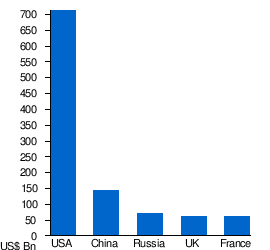
| Rank | Country | Spending ($ Bn.)[3] | % of GDP | World share (%) | Spending ($ Bn. PPP)[4] |
|---|---|---|---|---|---|
| — | World total | 1,735 | 2.5 | 100 | 1562.3 |
| 1 |  United States United States |
711.0 | 4.7 | 41 | 711 |
| 2 |  Chinay Chinay |
143.0 | 2.0 | 8.2 | 228 |
| 3 |  Russiay Russiay |
71.9 | 3.9 | 4.1 | 93.7 |
| 4 |  United Kingdom United Kingdom |
62.7 | 2.6 | 3.6 | 57.5 |
| 5 |  France France |
62.5 | 2.3 | 3.6 | 50.1 |
| 6 |  Japan Japan |
59.3 | 1.0 | 3.4 | 44.7 |
| 7 |  Saudi Arabiaz Saudi Arabiaz |
48.2 | 8.7 | 2.8 | 58.8 |
| 8 |  India India |
46.8 | 2.5 | 2.7 | 112 |
| 9 |  Germanyy Germanyy |
46.7 | 1.3 | 2.7 | 40.4 |
| 10 |  Brazil Brazil |
35.4 | 1.5 | 2.0 | 33.8 |
| 11 |  Italyy Italyy |
34.5 | 1.6 | 2.0 | 28.5 |
| 12 |  South Korea South Korea |
30.8 | 2.7 | 1.8 | 42.1 |
| 13 |  Australia Australia |
26.7 | 1.8 | 1.5 | 16.6 |
| 14 |  Canaday Canaday |
24.7 | 1.4 | 1.4 | 19.9 |
| 15 |  Turkeyy Turkeyy |
17.9 | 2.3 | 1.0 | 25.2 |
- ^ SIPRI estimate
- ^ The figures for Saudi Arabia include expenditure for public order and safety and might be slight overestimates.
This is why the US is often in the spotlight as they are the most armed country in the world. So again, turning to this massacre of children in the United States only serves to highlight the violence inherent in a culture that does not question its activities on the world stage in the name of defence and fears raised to demonise ‘the other’ rather than problem solving to de-escalate tensions, which go further than diplomacy, venturing into true conflict resolution as a responsible world citizen. The US can provide a powerful example of democracy at the international level by not arming up but by showing the true nature of life, liberty and happiness in nonviolence. Obama himself asserts Gandhi as his hero at what point does the world decide that what Gandhi demonstrated was true power. The power of love is not a ethereal comment nor is it a weakness that we relegate to personal relationships, it is to project this power into the world community as we are indeed each others keepers. If we don’t we wear the ramifications of retaliation and others emulating the example of power over rather than remembering the virtue of true power within (compassion, integrity, honesty, love, awareness, peace). These are not ideals they are the solid foundation and the real security of human affairs. They lead to valuing human life and desiring to solve problems at the root, they move us to give freedom to others by respecting differences rather than forcing compliance to our way as the best way (superiority). Learning that true happiness returns to us through resolving underlying conflict and living the philosophy of ‘to thine own self be true’. This is the beginning of true freedom and rather than looking for threats outside of the United States (or any other country) looking within at the fear levels, the media, the movie industry promoting violence, aggressive leadership, propaganda (demonising others), the masculine stereotypes leading men away from their humanity and the consumer society separating people through materialism and promoting greed over serving society. Principled leadership leads to the happiness of all people and is itself visible and honest in all its dealings. How can a government ask its people to be ‘good’ citizens if it is engaged in activities that are violent and not living by example the democracy it says it stands for? Democracy is not a mere word it is truly giving the people a voice to determine their future, to truly sit down and hear (listen deeply) to the concerns of people and give them an avenue to contribute to solutions in their society. In my view this includes business organisations as people spend most of their time at work. Thus extrapolating representation by the people for the people as a central and lived concept across society and one of the solutions to the violence we are witnessing worldwide that emanates from a Culture of Violence that is largely accepted and promoted as power. In truth it is the deepest weakness and denial and renders people disempowered and despairing for the future.
Most fear in my viewpoint is created through the media most notably the movie industry that is increasingly violent revealing more and more violent acts and available to unsupervised children through global television networks. Now why is this is a problem? Violence without responsibility shows the violence without any discussion around what causes it, how it can be de-escalated and narratives about lessons learned and solutions to avoid it in the future. None of the wisdom is available in conventional movies, what we see is violence continually used as the decider of winners and losers using graphics and action to attract spellbound interest without moral or values visible. It is to stimulate the senses and cause maximum shock as a means of keeping people watching. The old adage fear sells is not untrue and people can become both desensitised and addicted to violence as a emotional stimulant from the safety of their own home or theatre. We see men predominantly as the ones armed and increasingly appearing as very physically strong and contrasted as good guys or bad guys. It is very simplistic portrayals of violent conflict that end when the most powerful beats the weaker. These are notions of win/lose where fear is the sponsoring thoughts of men for centuries. We are now seeing gratuitous violence being peddled to children in violent video games and advocated as fun, but primarily the principles are the same. It is to use weaponry to win the game. It is typically defining the male stereotype as violent and the power that they all feel when they win. Yet this is a false power and always has been as we can see when we look around the world. It does not promote conflict resolution, problem solving, gentleness or indeed peaceful societies. It is still a primitive imagery where the tough, strong and aggressive win and are applauded unquestioningly if they are on the side of good. In truth, the side of good is nonviolent and promotes unity for the greatest good. This is not depicted as strength.
I would like to venture into some psychology to flush up what is typically unseen in respect of how violence is depicted. What I find interesting when I see films as a person trained in conflict resolution, is I firstly look to see what is the problem that is causing the conflict in the film (or real life). What is never mentioned or made visible is that the strong men are actually deeply frightened underneath. Violence in truth is a call for help, it comes from fear that requires defence or attack to protect oneself. They are not in a state of love or peace. This will never be revealed. They will keep their faces impassive to conceal their true feelings because men have been trained that to be real men they must be physically strong, show no emotion. This subconsciously is regarded as a silent strength and power. A pretence that there is no fear when in most cases men are deeply afraid, ask any war veteran. The violent behaviour is communicated as good if it is done on the side of good, which is seen as defending some perceived good or virtue, these are the subtle messages sent. So we like the heroes even if they have just mowed down a group of people in the name of courage or on behalf of their people. Deep down men admire this courage as they are seeking their manhood which is really a desire to face what they fear but the distortion is that violence has been used as the testing ground rather than situations where fear arises – wild animal, saving a persons life, running into a fire, clowning in Afghanistan (e.g. Patch Adams), adventuring (Richard Branson) and testing physical boundaries (Man versus the Wild), challenging beliefs about war and peace (John Lennon), democracy leaders (Aung Sun Su Kyi), facing governments nonviolently (Gandhi) and the list goes on. The reality is that the problem solving in films and real life are either undeveloped or non existant in respect of there being no questions or philosophical reflection revealing the psychology of their negative portrayals in thoughts or actions or providing alternative ways and means that give food for thought for the real problems to be identified and solved. Typically we see people shooting others with no empathy shown for the other or reflection on what has happened or indeed what was the reason underlying the violent behaviour nor to understand the nature of the pain under the surface that requires healing for a truly happy ending.
The matrix comes to mind, whilst I could see the philosophical story beneath the violence, I marvelled at the impassive faces as bullets were flying and people were getting off on the cartwheels and bending and special effects. There was no deeper thoughts. I am sure there were two types of audiences one type that really understood the question regarding which pill to take the blue or red which translated into living the false life or the deeper life of truth. That is one audience the other just saw the violence and got excited and felt powerful that Neo was invincible in the end without realising that the real power in the universe comes from love. That message was not emphasised, the message of being plugged into the matrix unconscious did seem to come across. Nonetheless the film is symptomatic of so many films where the heroes, both men and women are violent and beat the other through superior power. So all of the real stuff that evokes learning wisdom in life is cut from the movie as they are only dealing with surface (structural) stories glorifying violence and special effects, this in my view reflects mainstream male thinking. I say that as most women I know have little interest in the violence. I hear mothers feeling exacerbated that they cannot stop the violence as the kids demand it and marketing inspires it.
If our thoughts create our reality it is not hard to extrapolate cowboys and indians and violent films into the international arena. We see international disputes depicted in film or real life whereby there is no narrative or airing of different viewpoints exploring the psychology of the underlying needs or fears of the ‘the other’ and why they are feeling threatened. The embedded media reporting on one side is a case in point. In this external visioning (media) there is no narrative about the need for real dialogue to understand the nature of the problem from both sides (communication) nor active listening (to truly hear) or problem solving to understand the real underlying core problem. Moreover, there is no discussion to determine ways to develop options and solutions to resolve the conflicts. We seldom see the hero solving the problem through compassion, gentleness and wisdom. Instead we are given very little information or indeed wise education in films or real life about the true nature of the conflict and how both parties can be helped to find harmony or in films to role model higher behaviours or realistic story lines where we come out of the theatre uplifted having learned something of humanity.
The film-makers don’t appear to have the depth of emotional intelligence and the films chosen predominantly are for maximum profit (films available cheaper than local film industries thus supplanting local content) rather than selected based on the social good. So which comes first the horse or the cart? Does the film industry incite the violence or is it a result of real life feeding into film? Which is emulating which? What about copycat killings,snuff movies (real murders on film) etc. The real issues and solutions are never made visible for the public to see and so any comment on media is usually superficial as we are increasingly dumbed down using media to relate as we feel increasingly isolated. The public are often left in perceptions of powerlessness and fear where they sense something is wrong with our world or left reeling from the massive violence in films and aghast at what is seen as entertainment or alternatively those that get off on the violence. I myself have walked out of a theatre with a friend totally stunned at the lack of storyline and overt violence with no compassion or meaning. I found I just couldn’t bare it. It was grotesque to sit through. Yet those who grow up on it, watching the same films repeatedly would see it as nothing to worry about and could quote word for word the lines. They see violence as normal and validated by society as it is available.
I suspect many do walk out of the real life movie theatre of orchestrated life and feel totally despairing about the shape of the world. None of the information imparted leaves people with a sense of understanding, awareness, solutions and hope. They are left with winners and losers and psychological fear which makes them lock their doors of their houses and cars and fear life. Some get nightmares, my friends son couldn’t bare to be left alone given all the violence he watche on tv, the images stayed with him at night. Did the film-makers (violent games makers) consider that impact on the quality of life for children and how it limits their freedom, happiness and innocence? It unconsciously sets up a narrative that the world is not safe and we should not trust our neighbours or families. Strangers knocking on the doors could be murderers, car stopping to help someone in the rain could be a pervert (my husband felt that when he wanted to innocently help a girl getting wet), that is how it pollutes our minds and blocks kindness. It also demonises men. I feel particularly sorry for them as they are typically looked at more with suspicion. It divides genders, ethnic groups, communities and this social division can be seen easily on public transport where people do not speak to each other. In my own experience on a train as a clown I found the people closed down in fear of being seen through the clown paying attention, believing the clown has an agenda (money) so they look at the floor, a book and pretend they are not there. They cut off from life rather than engage with the innocence that a person dressed as a clown is there to bring joy into their lives. I smile a lot at people and watch to see if they look or stay in their own world, increasingly they are afraid to look or they think it strange (that is dysfunction). The public are constantly fed on a diet of fear, mistrust, mental illness, lack of security, danger and the need for increasing protection. This is the Hobbesian world of tooth and claw (Thomas Hobbes enlightenment philosopher) rather than the Lockean world of libertarians, cooperation and justice (John Locke philosopher).
The seeds of fear create the arms races and calls for more funding for defence, more police, more discipline in schools, more security in a myriad of ways and increased spending on weapons. Seldom does the media or movie industry (on balance) inspire peace and social harmony and show another way of entertainment as promoting the higher wellbeing. This is the voice that is never heard at the square table hosting those invested in a Culture of Violence, this is the table of hierarchy and inequality. What we require is a round table (King Arthur’s nights legend) of wise and courageous persons who will advocate for a Culture of Peace birthed in equality, liberty and happiness. True representatives of human security.
I want to now move to the positive subject of peace and social harmony. If you truly want to see change occur across the planet I would suggest learn about peace and harmony in your own life. Root out all the negativity, go to www.thework.com to start to inquire into your own unquestioned thoughts. Have a look around your family how do you speak to them? do you order them to do this or that? do you get angry and punish if your way is not conformed to? do you gossip about others? do you complain and vilify those the television has told you are ‘bad’, ‘dishonest’, ‘wrong’ and so on. Investigate what you choose to bring into your own consciousness is it positive or negative? does it promote happiness or does it increase fear? What I typically do is look at anything in the media and ask – is it dividing people (us and them) or inspiring unity (solutions)? If I want to know if we are being manipulated I look closely at the language and I do some research. I have found deception is very clever in appearing to be offering up virtues and goodness but subtly undermining another or suggesting they are against/opposite in some way. Just be very careful what you believe and question the sources. I always check the sources and go further to find out what the agenda really is. On the internet there can be many fronts and it is harder to determine if they are legitimate sources or not. My feeling would be to focus on what you know in your own experience, do not discount your own wisdom, go with your gut feel or intuition, listen to the small voice within that nudges you this way or that.
For me I see the world as an incredible place. In my experiencing travelling around the world I was helped by everyone, not one person stole from me and I was met with only kindness and goodwill. When I travelled around Australia alone I met so many travellers who shared food, discussion and comments about the world. I never had a problem. I have been taken in by strangers to help me as I didn’t have a place to stay, quite often people have trusted me. I now move house regularly (house sitting) as I am a peace educator and society at this point in time does not understand or value this area as essential to education, it simply is not promoted, so work is not so easy to create. I recently discovered that schools have crowded curriculum and if you are not a trained teacher (even if an expert) they tend not to take you up (in Australia). Moreover, the consciousness around peace education is not well understood and doesn’t have government department’s behind its development in schools. This type of education with a universal values orientation is essential as a means of dealing with violence and bullying behaviour. Students learn about values such as compassion, empathy, responsibility, honesty, love, integrity, caring, cooperation and peace etc. Children learn to recognise bullying behaviour as essentially representing a powerless person trying to take power and that this can only occur if people allow it or groups of people ignore it. Moreover, to learn conflict resolution or restorative justice is to learn to face problems not as a means of blame but truly expanding understanding what is driving behaviour and finding creative/positive solutions so that all can learn and grow in order to coexist happily together. This of course would need to be taught in the community as much of this behaviour is learned in the home and exacerbated by perceived social fears, family breakdown, apathy and low self esteem.
In my own life I don’t worry about this current state of play or the diverse mindsets. I use my own experience as a means of practicing peace by learning to accept ‘what is’ and learning to live with less and experiencing true freedom. I have learned I don’t need much to be happy, I don’t need a partner, a job, a house or loads of friends to endorse my essential value as a human being. I have realised that my happiness comes from being truthful to myself and doing what makes me happy. This blog is an outpicturing of my own happiness as I allow myself self expression and participation in democracy (living democracy), meditation, public speaking as a clown to the community, clowning around, teaching from time to time, connecting with the public randomly, walking in nature, making up each day allowing it to unfold naturally, never knowing where I will live (surprise) and feeling such positivity I almost jump out of my skin with joy at being alive. I feel a resonance with life that feels like being on the verge of excitement. So I know I am in harmony with myself and what I am being is in alignment with my own truth. Thus I feel deeply happy with myself and where I am going. I have found an inner connection to peace that is always with me even through ups and downs. I find myself smiling constantly as I am starting to see the experiences entering my life are for my highest good. If negative events occurs I look for the wisdom within myself, I look to transform a negative situation into a positive one, I choose not to hate but solve the problem or communicate in better ways sensiive to others needs. I look deeply into my own pain and face it, I don’t run away from my responsibility in conflict but try to understand with compassion what is causing my pain and spare a thought for the other. Many times I have used my own psychological and physical pain to deepen empathy for the world around me. I recall using period pain in this way, I imagine the vulnerability of those unwell in intense pain and their need for care. It humbles me. In respect of others feeling emotional pain as anger, I may notice I am in judgement I then remind myself that I don’t know their situation (not in their shoes) and am likely to be wrong. When I teach peace, I say to kids ‘what is the most intelligent thing you can say in life?’ They say a few ideas, some say ‘I don’t know’ … close. I respond the most intelligent statement is ‘I might be wrong’. They would ask why – I would say because you create space for other possibilities, you open your mind. The moment you conclude (I am right) you close your mind. So to be open invites other possibilities because how can we know everything, how can we be 100% right? So as a result of this philosophy I now give other people a chance to at least say what is going on for them without judgement. That is democracy and peace in my view. How many relationships breakdown through misunderstanding and false conclusions or feeling hurt so you just dump the person rather than investigating for truth? If my experience makes me look into greater social ills I then think of creative ways I could help others and use my personal experience as my viewfinder and live what Gandhi envisaged ‘to be the change I wish to see in the world’. If I want peace I then have to be it e.g. study it, walk the talk, teach peace, discuss it, meditate on it, find ways I can be in harmony with myself and others. I have to look at the shadow (denials, fears etc) of humanity and seek to understand the fear and the pain and then look into myself and see my own shadow there as well realising I am the microcosm on the macrocosm. How many of us really honestly see the negativity outside as also in themselves? We may judge a person as unkind, when have we been unkind? We might see cruelty, recall when you were cruel? Someone killed someone, when have you been angry enough and said or thought something violent? So how can I blame anyone when every person holds the same negativity and put under the same circumstances/experiences would do the same.
So how do we move forward? how do we envisage a future worthy of children where all grow up in balanced family lives? (we start with our own family) how do we create safety on the streets? (be safety to others on the street, get involved) how do we stop bullying? (explore power over/within) what sort of future do we really want and then choose it! You live the future you want by example and others will follow but do not tell others how to live. Hard lesson for me as I am a good advice giver. I am starting to realise that life happens on purpose and there is much I do not know about what comes out of difficult events, the good that emerges as people desire the opposite. The same goes for shootings, the shock will probably create counter movements for peace, for re-evaluting our society and demanding real change. It is wise not to judge but to simply choose who you are in relation to an event/person. Each has to find their own way, we are all here to remember who we are and life sends us experiences in which to feel the contrasts, to make decisions, to choose, to decide if we love ourselves or not. Life is not unintelligent or inanimate you only have to look at the web of life and the interconnections and perfections of a planet we have lived on for the equivalent of 1 minute to midnight. We do not know where this planet comes from, who or what created the DNA, the intricate design of life, nor can we even imagine the extent and breadth of the cosmos and the trillions of planets reaching infinity. We are only aware of what we are taught from a limited his-story (her story is untold mostly) and outside of that box we have no idea.
I will leave you with a few more thoughts and then must go and dance with the traffic. Have to add in here why don’t we all work at different times (clock on/off) then traffic would not be a problem. Everyone has different biorhythms, I prefer to work late and start late, some like getting up early. That would be a way of creating harmony at work. Why not have everyone work part time for 3/4 full time wage so that we have enough money to cover basics and have plenty of time with partners, children and friends. Why is it that people have to work so many hours when the point of the economic system was to serve us. Questions are very important for opening the mind and if you are seeking to do this creatively then solutions will arise. That is how creative thinking works, we don’t just grizzle about the traffic or work we proactively create the change in us and then spread it to others through blogs, letters, discussions, events etc. I like the clever use of react or create. See how in reaCt there is a ‘c’. If you move this to the front of the word it becomes Create. So when you see first you create, so look within for answers and allow your creative side to flourish. If you don’t ‘c’ first you react and are governed by reaction or fear rather than empowerment. To create is often perceived as the feminine which exists in both men and women. It is where we connect to greater truths and our emotions. As we engage with our feeling side intuition emerges more strongly and inner navigation guides us to real happiness. As Einstein said “No problem can be solved from the same level of consciousness that created it.” Seek for truth and consciousness awakens, interesting hey. I like the question ‘is it better to be right or happy?’ This is a profound statement, those seeking to be right may not be looking for truth, they seek to be seen as knowing better. Seeds of superiority sit there and hence, division. Happiness comes from knowing yourself and not concerning yourself with others judgements, but living your truth quietly and honestly. You feel happy as you were true to you, that is the meaning in my mind beneath the question.
So to move to complete the full circle. I started this conversation prompted by the massacre of children in the United States. I felt myself viewing the world as remaining in a Culture of Violence, I saw the militaries spending great wods of money recreating that fear through more violence and the preparation for enemies and violence. I travelled throught he emotional array and the importance of understanding that emotional suppression causes violence and distortion. I saw the movie industry, the news and other media fuelling that fear by envisaging it with more and more terrifying themes. I saw the violent video games promoted as fun for kids (mostly boys) role modelling violent stereotypes seeking to kill and destroy as point scoring competitively rather than games that problem solve in peace settings or construct new civilisations or learn about who they are through the magic of their own consciousness. Only girls games seem to promote what is gentle and kind (virtues of humanity) as strengths. Why is this? I go to my own experience – I love a challenge, I don’t need a pretty dress or to feel valued. I am interested in knowing who I am, solving problems, creatively exploring the universe, inventing new ways to educate, laughing and clowning on the streets, travelling the world, parachute jumping, deep sea diving, building a mud brick house (on the horizon) and so on. No games promoting this for females. So just wanted to add this in as I noticed it. Thus going back to the main theme of the Culture of Violence, these sponsoring thoughts emerge from fear that is unquestioned and largely unconscious. Our ego (separation from others) is what we listen to when we only think of self interest rather than best interest. This selfishness is created by a separation mentality and promoted through our economic system of greed and increasing profits without social conscience or human rights. We can see commercial interests including defence contractors profiting from violence and justifying their presence as defence or national security or simply disassociating commercial interests from the social impacts of their product or service until there is protest or public outcry. We see violence in gender stereotyping, in the family, in our thoughts and ultimately it comes down to the responsibility of all of us to be the change. Gandhi is a great example of ‘be the change you wish to see in the world’, resolving underlying conflict through nonviolence, asserting truth and love, conflict resolution, peace education and developing societies in our own vision of peaceful and harmonious. We can all do this, but first we must look at ourselves as the world is a reflection of ourselves. We were not born violent (see Seville Statement (refer http://www.unesco.org/cpp/uk/declarations/seville.pdf), we were born peaceful and who has ever viewed a baby as violent. They are vulnerable, defenceless and when they smile they disarm us all, as they are the future. We are the ones that fill their minds with fear as we stop them from doing this or that, we instil fear for their protection but end up creating unrealistic fears in life. We try and cotton wool them to make them safe rather than teaching them discernment, resilience (bouncing back from problems), peaceful behaviours, dealing with difficult people, how to live courageously without fear, to learn from life and move on bravely. My work in peace education and values is about knowing yourself, experiencing the virtues within and learning how to live peacefully together by valuing differences, looking at ourselves and learning how to resolve conflict and convert negativity into positivity. Importantly children need to learn critical thinking (problem solving, questions) and develop their creativity and emotional intelligence to create a better future which is expanding and fun. We have so much to remember about who we really are and I can assure you, you are unlimited, your beauty is breathtaking, your wisdom is sitting there awaiting your voice, you can solve problems and your talents is your bounty here to be shared with the world. You can empower yourself to heal the past, the wounds, the anger and you can transform your life into an inspired empowered life where others just marvel at how far you have come. You are growing all the time and moving into unprecedented times ahead. The world waits for you to shine your light.
The future will be about inner and outer peace. It will be a society where we are each other’s keepers where we all take full responsibility for our world and the world at large. We will be mindful of what we ingest into our bodies, the friends we choose, the media we watch, the hobbies we engage in and we will ensure that it is healthy and positive. As these changes slowly permeate this world you will find more inner inspiration and peace like a wellspring where you will look at others not has detached strangers but community members who feel like family. You will feel the celebration in life and be deeply grateful for each moment. You will feel you connection to life as deeply profound. That is awaiting all of us in the future and it is real. For only love is real and when you find this truth within yourself a new world will emerge.
So if you don’t like what you see in the world, change yourself, share your creative visions, live to your highest potential and that will change your world. There is not one person on this earth that is hopeless or a loser, every single person can be the greatness they admire, if you see it, it is in you. Hold that vision and keep on remembering it, you may be surprised to see it happen. That is the creative future awaiting you. Create a future worthy of all children.
I send you happiness and love.
Love from a peace clown.
Leave a Reply
You must be logged in to post a comment.