US Crossroads: Investing in War (fear) or Peace (love)?
I see the title in two ways US as United States and US as us. I see the same paradigm choice for all people. It is time to change and work towards solving the problems that have beset us for centuries. It will not only take for society to vote in peaceful leaders but for the society to choose peace also. We are in this together.
Gandhi once said “I’m simply going to prove to Hindus here and Muslims there that the only devils in the world are those running around in our own hearts.” I said this to Scott Ritter (former weapons inspector in Iraq). I told him there is no enemy. There is a problem to be solved and peace education and conflict resolution is one of the ways to resolve conflict. I spoke to him at length about my own work in schools as a peace clown, he said he would have to re-write his book.
I would like to see the future book re-written. A new story and a new paradigm. The beginning would start with war isn’t intelligent and it does not lead to peace. Only peace leads to peace.
The United States is at a crossroads they are facing financial crisis which is forcing them to cut military spending. However, decisions can’t be made from a base of financial excesses as the reason for change, at some point there has to be a deep reflection on why the wars don’t work. To understand the depth of the pain inflicted through firing weapons from both sides, the insanity of killing people and to find glory in the win. As if somehow this makes you superior or a better country. There has to be an internal change to give up violence in favour of the hard work of real freedom. At what point is the real war within, over.
Gandhi is a good example, he ended the campaign for non-cooperation with the British because policemen were killed. Nehru and other Indian National Congress leaders (opposition group) argued it was only a few men. Gandhi saw no solace in that rationale, he said ‘tell that to the families of the men who died’. The fact that violence occurred was the impetus to end the campaign, as it was not nonviolent. His colleagues couldn’t understand his logic and felt they would lose all they had gained in their movement against British occupation, but they essentially lost the real point. Gandih’s vision was about restoring Indian dignity and sovereignty through satyagraha (holding on to truth) and ahimsa (nonviolence, love). The colleagues saw the ends justifying the means and minimised the deaths rather than understanding that the means (nonviolence) was central to success. Gandhi chose to fast as a penance for his role in arousing such passions. He would not stop until the violence stopped. His love was so great that the violence was stopped between Hindu’s and Muslims. Gandhi demonstrated the power of leadership in service of peace. Below is a brief overview of the situation.
http://www.yale.edu/ynhti/curriculum/units/1998/3/98.03.05.x.html
The Tragedy of Chauri Chaura. A peaceful protest in support of Gandhi’s Home Rule campaign turned into an attack on a local police station. Twenty-two local policeman were hacked to death by a mob who set the police station on fire and then murdered them as they emerged. Gandhi, in order to enforce the end of non-cooperation with the British, told the people he would go on a fast unto death if necessary; he would fast until the people stopped protesting. He achieved his goal but almost died in the process”
Until nonviolence, conflict resolution, peace building whatever positive label you wish to give to unity, until it becomes a national creed, it is lip service in service of power. To create a cultural change it would be seen as a national priority to teach nonviolence, conflict resolution, peace and values in schools, within families, at workplaces as a new global mantra. Where we truly learn to respect others, value differences and take responsibility for conflict rather than allowing fear to dictate. Greatness does not come from power over others, it comes from knowing your own true power within. It arises from virtues and values such as love, compassion, empathy, responsibility, respect, honesty and integrity to name a few. It is virtues that lead to greatness of spirit.
Imagine spending these enormous sums of money on genuine peace building and peace education in the community. Then people will not have to suffer endless wars inflaming fundamentalism on all sides. Interestingly, there are more important priorities such as alleviating poverty, affordable housing, liveable neighbourhoods, safety on the streets, equality, purpose and mission, vibrant health, authentic happiness, that in a compassionate society, would consider the first priority. You will note I went for the positive rather than the social problems, when we focus on what we want we might actually just get it.
http://abcnews.go.com/Politics/OTUS/2000-dead-cost-war-afghanistan/story?id=17367728#.UKGO2merHmk
2,000 Dead: Cost of War in Afghanistan

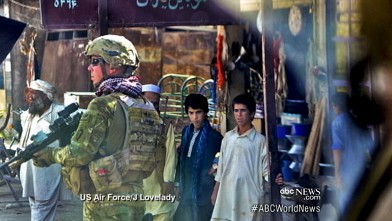
Seven days before the 12th anniversary of the U.S. invasion of Afghanistan, the war reached a deadly and tragic milestone this weekend as the 2,000th American soldier died in combat.
While U.S. and NATO forces are years away from a full withdrawal, tens of thousands of American soldiers have come home this year as the United States began transferring responsibility to Afghan security forces.
Here is a look at the price, in both lives and dollars, that Americans and Afghans have paid over 12 years of war.
ABC’s Luis Martinez and the Associated Press contributed to this report.
| 4,012 Days |
The United States has been at war in Afghanistan for 4,012 days, six days short of 12 years. Troops arrived on Oct. 7, 2001, less than a month after the terrorist attacks of Sept. 11.
| 2,000 Americans Killed |
In the 12 years that American troops have been fighting in Afghanistan, 2,000 have been killed. The 2,000th death was reported in eastern Afghanistan Saturday and was suspected to be an insider attack by Afghan forces.
There has been an alarming uptick in these insider attacks on U.S. and NATO troops this year, with Afghan soldiers and police, who have been trained and armed by coalition forces, killing 52 U.S. and other NATO troops since January.
The most deadly year of the war to date was 2010, when 492 Americans died.
During the first nine months of 2012, 254 members of the U.S. military lost their lives in Afghanistan. A total of 549 Americans have died in the war-torn country in the year since Osama bin Laden was killed in May 2011.
| 17,644 Americans Wounded |
More than 17,000 U.S. troops have been wounded in action since the Afghanistan war began in 2001.
As a point of comparison, nearly 30,000 U.S. military members have been wounded in the Iraq conflict since it began in 2002.
About 4,500 Americans were killed in Iraq during the nine-year war that formally ended in December 2011.
| 68,000 Troops |
There are currently 68,000 U.S. troops stationed in Afghanistan. That’s down from the peak troop level of about 100,000 who were stationed there in March 2011. By the end of 2014, most U.S. troops are expected to be out of the country.
About 40,000 additional troops from America’s allies, such as Great Britain, are also stationed in Afghanistan.
| 13,009 Civilians Killed |
According to the United Nations, more than 13,000 Afghan citizens have been killed between 2007 — when the U.N. began reporting such statistics — and June 2012.
Nearly 2,000 civilians were wounded in war-related incidents during the first six months of 2012. About 1,145 civilians were killed in that same time period, according to U.N. totals.
| $1.2 Trillion |
The war in Afghanistan has cost the United States nearly $1.2 trillion — or $1.172 trillion, to be exact — since its inception in 2001 through July 31, 2012, according to the U.S. Defense Department.
According to a Pew Trusts report, the wars in Iraq and Afghanistan have contributed more to growth in U.S. debt than any other policy since 2001 except the Bush-era tax cuts and the increased interest from legislative changes.
Leave a Reply
You must be logged in to post a comment.