Defence Cuts? Eisenhower Warned Greatest Threat Was A Large Industrial/Military Complex
This blog is about US military cuts to defence spending. Thankfully Australia has seen the wisdom and cut defence spending. It is clear that superior technology doesn’t win wars. A wise move. Perhaps there are open minds seeking another way to ensure real peace and security.
Note: This is a 2018 update. Australia is investing $200 billion in military spending. This country has become an arms trader.
This excerpt is from the article below and is the core of the issue in my view:
[During his 1961 farewell address, President Dwight D. Eisenhower famously warned the American people that one of the greatest threats to freedom came not from enemies abroad but from “the conjunction of an immense military establishment and a large arms industry”]
If you want to stop bullying do you bring in bigger bullies or do you help people understand that violence does not solve problems? Moreover, the community (bystanders) have to take responsibility and develop strategies to ensure: 1) bullying is unacceptable 2) community becomes involved as mediators 3) apply restorative justice models to deal with the disputed parties directly and to offer solutions to resolve the underlying conflict. In a international context it is to create an international environment of nonviolence and disarmament. It is to lead by example and work on changing the international environment from one where might is right to one where there is a international democracy which shares power, each has an equal vote at the United Nations and international governance is representative and no longer a toothless tiger as they say. People’s of the world need to have a say over what governments are doing in their name as many are becoming the victims in war zones that not only destroy combatants but 90% of civilians and the economies that support the sustainability of life during war and post war. Lastly, people have to stop watching Hollywood movies and playing violent video games believing that violence is a cool way of dealing with so-called enemies (bad guys) and that the big muscly Rambo’s are a false stereotype to true courage and strength. The greatest strength is best summed up by a little bloke in a loin cloth, Mahatma Gandhi:
“Nonviolence is the greatest force at the disposal of mankind. It is mightier than the mightiest weapon of destruction devised by the ingenuity of man. Destruction is not the law of the humans. Man lives freely by his readiness to die, if need be, at the hands of his brother, never by killing him. Every murder or other injury, no matter for what cause, committed or inflicted on another is a crime against humanity.”
A culture of peace, departments of peace, conflict resolution and values will create an environment where we can start to seriously solve underlying conflict. That is the world we will move into and for some, it will be kicking and screaming, but ultimately there is no choice as the world cannot afford military spending as a solution to conflict and as we discover, it escalates the problem with more violence. We have to start to tackle the real reasons behind conflict and educate the public, politicians and military personnel to instill values, problem solving and conflict resolution into our future modus operandi. That is the beginning of social responsibility and a society that builds a Culture of Peace from the grass roots. That is my vision.
Let’s first look at spending comparisons to get a sense of proportion.
http://en.wikipedia.org/wiki/List_of_countries_by_military_expenditures
SIPRI Yearbook 2012 – World’s top 15 military spenders
|
|
| The world’s top 5 military spenders in 2012. Figures sourced from the SIPRI Yearbook 2012. |
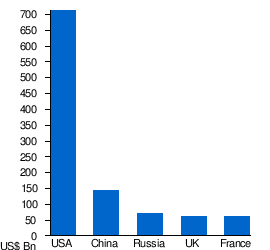
| Rank | Country | Spending ($ Bn.)[3] | % of GDP | World share (%) | Spending ($ Bn. PPP)[4] |
|---|---|---|---|---|---|
| — | World total | 1,735 | 2.5 | 100 | 1562.3 |
| 1 |  United States United States |
711.0 | 4.7 | 41 | 711 |
| 2 |  Chinay Chinay |
143.0 | 2.0 | 8.2 | 228 |
| 3 |  Russiay Russiay |
71.9 | 3.9 | 4.1 | 93.7 |
| 4 |  United Kingdom United Kingdom |
62.7 | 2.6 | 3.6 | 57.5 |
| 5 |  France France |
62.5 | 2.3 | 3.6 | 50.1 |
| 6 |  Japan Japan |
59.3 | 1.0 | 3.4 | 44.7 |
| 7 |  Saudi Arabiaz Saudi Arabiaz |
48.2 | 8.7 | 2.8 | 58.8 |
| 8 |  India India |
46.8 | 2.5 | 2.7 | 112 |
| 9 |  Germanyy Germanyy |
46.7 | 1.3 | 2.7 | 40.4 |
| 10 |  Brazil Brazil |
35.4 | 1.5 | 2.0 | 33.8 |
| 11 |  Italyy Italyy |
34.5 | 1.6 | 2.0 | 28.5 |
| 12 |  South Korea South Korea |
30.8 | 2.7 | 1.8 | 42.1 |
| 13 |  Australia Australia |
26.7 | 1.8 | 1.5 | 16.6 |
| 14 |  Canaday Canaday |
24.7 | 1.4 | 1.4 | 19.9 |
| 15 |  Turkeyy Turkeyy |
17.9 | 2.3 | 1.0 | 25.2 |
- ^ SIPRI estimate
- ^ The figures for Saudi Arabia include expenditure for public order and safety and might be slight overestimates.
Reflection: why does the US need to spend approximately 80% – 90% more than the top 5 military budgets?
Imagine (reminds me of someone) if trillions were spent on peace building and peace education … excuse me just dreaming for a second. I forgot where I was…
This is a paper below is from Transcend. The founder of Transcend is Johan Galtung. Here is a quick Wikipedia overview.
Johan Galtung (born 24 October 1930) is a Norwegian sociologist, mathematician and the principal founder of the discipline of peace and conflict studies.[1] He founded the Peace Research Institute Oslo in 1959, serving as its director until 1970, and established the Journal of Peace Research in 1964. In 1969 he was appointed to the world’s first chair in peace and conflict studies, at the University of Oslo.
The Invincible Military-Industrial Complex
by Veronique de Rugy – Reason Magazine
Leon Panetta’s Dream Is Eisenhower’s Nightmare
During his 1961 farewell address, President Dwight D. Eisenhower famously warned the American people that one of the greatest threats to freedom came not from enemies abroad but from “the conjunction of an immense military establishment and a large arms industry,” which over time would lose sight of defending the United States and become devoted only to its own perpetuation. “In the councils of government,” said the man who had commanded the Allied forces in Europe during World War II, “we must guard against the acquisition of unwarranted influence, whether sought or unsought, by the military-industrial complex. The potential for the disastrous rise of misplaced power exists and will persist.”
Today we are living Ike’s nightmare. Defense spending is not just one of the most sacrosanct parts of the budget but also one of the largest and most inscrutable. Adjusting for inflation, military spending has grown for an unprecedented 13 consecutive years and is now higher than at any time since World War II. Even excluding war costs, the military baseline budget has grown by about 50 percent during the last decade.
Yet the faintest suggestion of a plan to reduce the rate of the defense budget’s growth inevitably triggers dire warnings that Americans will soon be speaking Russian, Chinese, Arabic, or the mother tongue of whoever is deemed the most powerful adversary of the moment. Consider the Pentagon’s reaction to the recent threat of defense spending reductions following the failure of the Joint Select Committee on Deficit Reduction (popularly known as the “supercommittee”) to find deficit savings of $1.2 trillion over 10 years. The lack of a deal triggered an alternative path to those savings: a sequestration that would cut projected overall spending by $1.2 trillion between 2013 and 2021. Half of those savings are to come from the defense budget—an annual hit of about $54 billion compared to current administration plans.
But don’t confuse that $54 billion with reductions from current spending levels. In August 2011, the Congressional Budget Office projected that discretionary national defense spending (96 percent of all military spending), excluding the wars, would cost $5.3 trillion between 2013 and 2021. After sequestration, that spending will instead total $4.8 trillion, or $500 billion less. That’s 10 percent less than otherwise projected (see the chart) but still 10 percent higher than current defense spending.
How did apologists for the military-industrial complex react to the possibility of an increase of just 10 percent rather than 18 percent? Defense Secretary Leon Panetta, in a November letter to Sen. John McCain (R-Ariz.), warned that if “maximum sequestration” goes into effect in 2013, “these cuts would be devastating for the Department.” One of Panetta’s deputies colorfully described the cuts as a form of “self-castration.” Former Defense Secretary William Cohen characterized the possible cuts as “draconian” and “calamitous,” Air Force Chief of Staff Norton Schwartz fretted that his branch “may not be able to overcome dire consequences,” and Sen. Lindsey Graham (R-S.C.) declared that trimming the rate of military spending growth would do nothing less than “destroy the Department of Defense.”
There is no basis in reality for such hyperbole. Adjusting for inflation, sequester cuts would freeze the military’s budget at its level in 2007—a year in which America was ably defended, and plenty of cash flowed to the armed forces.
All these numbers underestimate the growth of defense spending. The data for 2013–21 exclude war spending, which will add roughly $400 billion during that period, even if the withdrawals from Iraq and Afghanistan proceed as planned. It also excludes mandatory spending, which adds another $6 billion a year on things like military retirement benefits.
When U.S. defense spending is placed in a global context, flipping out over “cuts” becomes even stranger. A country’s defense budget should be a function of its security needs—the cost to guard against the threats it faces. Secretary Panetta has noted that “threats to national security would not be reduced” in the face of budget cuts. But it’s far from clear that current spending is commensurate with the dangers the U.S. faces.
Data from the Stockholm International Peace Research Institute’s military expenditure database show that the United States spent $728 billion on its military in 2010, or about 45 percent of the world’s $1.6 trillion total, more than the next 14 largest military spenders combined and nearly six times more than the next biggest spender, China. Most of the other countries at the top of the list are American allies. With or without the automatic cuts to defense from the Budget Control Act of 2011, the United States will remain the biggest global military power for at least a generation.
Defense hawks may have some legitimate gripes about sequestration: Since 42 percent of the cuts in the budget deal come from military spending, defense, which accounts for about 20 percent of annual spending, is being targeted disproportionately. Furthermore, Cato Institute research fellow Benjamin Friedman argues that sequestration is an inefficient method for resizing government. When it comes to military spending, the process doesn’t allow for prioritization—cutting less important missions and programs to fully fund more critical ones. As written, the law applies equally to all military accounts. The president can choose to exclude only personnel spending.
Overreliance on across-the-board defense cuts was meant to maximize the pain of sequestration. The idea was to encourage each side of the supercommittee to sacrifice in order to reach a deal, meaning tax increases for Republicans and domestic spending cuts for Democrats. The committee’s failure doesn’t end those negotiations; it broadens and extends them.
Defense hawks, however, should be careful what they wish for. Unless Congress changes current law, New Year’s Day 2013 will bring both sequestration cuts and the expiration of the Bush tax cuts, two outcomes Republicans wish to avoid. By exaggerating the impact of defense “cuts,” conservatives are giving President Obama important leverage to win revenue increases in exchange for overturning sequestration.
It doesn’t have to be this way, Friedman notes. Rather than bellyaching about a somewhat smaller spending increase, Panetta could offer an alternative that allows the Pentagon to choose more wisely among its priorities while bringing spending levels down to a level compatible with adequate national defense. That option would relieve pressure for tax increases while allowing the American people to enjoy the dividends from winding down two expensive wars. But if Eisenhower was right about the military-industrial complex’s insatiable need to keep increasing its budget, size, and influence, it is foolish to expect any defense secretary to propose wiser spending, let alone agree to spend less.
Leave a Reply
You must be logged in to post a comment.