Gandhi: Sabarmati Ashram of Spiritual Community
I visited this ashram in 2010. For me it was an emotional experience when I walked around the open air museum. It was like grounding my feeling around Gandhi, this was a real person who gave up everything to know god. For him god was truth. He was right. Of course many people have different versions of truth but to reach the indefiniable you have to reach within yourself. You won’t find it in a book and that awakening comes from virtue. The idea of not being able to pass the camel through the needle is the idea that you cannot access this higher knowledge until you yourself have reached a level of humility. It is like the child is unable to see through the eyes of a wise person. Wisdom is seeing the world differently but always from a place of peace and love. That is how you know it is wisdom, the person has found harmony with all that is. Gandhi started people on a path to understand true power doesn’t come from force, he spoke of soul force but in truth it has no force inherent it is an energy of total allowance, giving and love. It is natural and flowing and loves all others. That is the beauty and indeed power of love. So few understand this magic these days as many are hooked up to technologies, working in routines that are focussed on tasks and objectives, not flow and unfolding. It is no mistake that we find more spiritually evolved people in so called primitive societies, there is less distraction and more contact with the true nature of life. Much has been disconnected in western lifestyles and a deep yearing for something else is felt, yet until we become still and reach within for our own truth, people like Gandhi will probably not come into view for many. However, as they say when the student is ready the teacher appears.
I had the priviledge to go to Gandhi’s ashram and I always laugh at myself crying when I entered the bookshop. I felt his presence there and a Satyagrahi took me on a tour. To my surpise she opened up his room and allowed me to sit with her. We sat on either side of the spinning wheel. I saw his staff in the corner and had to grab it. I had dreamed once he came to me and it was short and sweet. The essence was being seen and the feeling of humility I felt at the time. It was dark all around but I could see the rim of his glasses. It was a powerful moment. I felt the tears at the ashram and as I sat there we spoke of peace education. I sat there in peace and deeply happy. Gandhi didn’t have any material possessions only the home spun he wore, his glasses, the spinning wheel and pratical items. Other than that his real wealth shone from within, he had found his purpose and connection and lived out his message.
An ashram is a spiritual place where people can reflect, sometimes they are called retreats, people may live there. I always laugh at the word retreat as I want to say progress. I am not interested in retreating from life, I want to dive deeply into it. The purpose of the isolated ashram in nature is to block out the noise of the world and look inwardly, to allow illumination from within, reconnecting with our true nature. This spiritual community is one of love and belonging, some live permanently others come occasionally. Typically people feel called to make these pilgrimages at least once in their lives. All at the ashram are striving to experience higher states of being, for some that is to touch god or a sense of expanded consciousness. It can be very exciting, all from being not doing. The ashram has been around since human’s crawled out of the cave, perhaps that is why that happened.
I remember years ago going to a Vipassana retreat for the first time. There was no talking just meditation and stillness. I have to say I did escape after a few days as I broke up with a partner and wasn’t still. Today I would be able to do it as I am finding the stillness. It comes with maturity and at the right time in ones life. I remember having accentuated awareness leaving the ashram, I noticed everything, I couldn’t believe how heightened my senses were. Just imagine turning inward for 20 years, I am sure your reality would change. So find a quiet space, create your own ashram and perhaps like Gandhi, you can re-create your world.
Peace, omshanti.
http://en.wikipedia.org/wiki/Sabarmati_Ashram
Sabarmati Ashram (Gujarati: સાબરમતી આશ્રમ also known as Gandhi Ashram, Harijan Ashram, or Satyagraha Ashram) is located in the Sabarmati suburb of Ahmedabad adjoining to famous Ashram Road, at the bank of River Sabarmati, 4 miles from the town hall. This was one of the residences of Mohandas Karamchand Gandhi.Mahatma Gandhi spent approximately 12 years of his life here.
This ashram is now a national monument established by the Government of India due to its significance for the Indian independence movement in the form of the Dandi March in 1930.
Contents |
History
The ashram was originally established at the Kocharab Bungalow of Jivanlal Desai on 25 May 1915. The Ashram was then shifted on 17 June 1917 to a piece of open land on the banks of the river Sabarmati. Reasons for this shift included: Gandhi wanted to do some experiments in living (e.g. farming, animal husbandry, cow breeding, khadi and related constructive activities for which he was in search of this kind of barren land.) It was believed that this was ancient ashram site of Dadhichi Rishi who had donated his bones for a righteous war, but his actual ashram lies in Naimisharanya, near Lucknow, Uttar Pradesh; it is between a jail and a crematorium, and he believed that a satyagrahi has invariably to go to either place. Mahatma Gandhi said, “This is the right place for our activities to carry on the search for truth and develop fearlessness, for on one side are the iron bolts of the foreigners, and on the other the thunderbolts of Mother Nature.”
While at the Ashram, Gandhi formed a tertiary school that mainly focused on manual labour, agriculture, and literacy to advance his efforts for nation’s self-sufficiency. It was also from here on March 12, 1930 that Gandhi marched towards Dandi, 241 miles from the Ashram, with 78 companions in protest of the British Salt Law, which taxed Indian salt in an effort to promote sales of British salt in India. This mass awakening filled the British jails with 60,000 freedom fighters. Later, when the government seized the property, Gandhi responded by asking the Government to forfeit the Ashram. The Government, however, did not oblige. He had by now already decided on 22 July 1933 to disband the Ashram, which later became asserted place after the detention of many freedom fighters, and then some local citizens decided to preserve it. On March 12, 1930 he vowed that he would not return to the Ashram until India won independence. Although this was won on 15 August 1947, when India was declared a free nation, Gandhi was assassinated in January 1948.[1]

Mahatma Gandhi’s Visitor Room at Hridaya Kunj
Present day

Gandhi Smarak Sangrahalay
The ashram now has a museum, Gandhi Smarak Sangrahalay. In 1963 the museum building was erected (designed by architect Charles Correa), and memorial activities were then started here.One of the important activities undertaken is the establishment of a Gandhi Smarak Sangrahalaya. Initially started in ‘Hriday Kunj,’ Gandhi’s own cottage in the Ashram, the Sangrahalaya has now shifted to its own well-designed and well-furnished building which was inaugurated by Jawaharlal Nehru, Prime Minister of India, on 10 May 1963.
Nandini: It is on the right hand side of ‘Hridaya Kunj’. It is an old Ashram guest house, where guests from India and abroad are put up.
Vinoba Kutir: Named after Acharya Vinoba Bhave who stayed here, and also known as Mira Kutir after Miraben, Gandhiji’s disciple, daughter of a British Admiral.
Upasana Mandir:It is an open -air prayer ground, situated between ‘Hridaya Kunj’ and ‘Magan Kutir’ (the hut where Maganlal Gandhi, the ashram manager, used to stay).Here, Gandhiji used to refer to individual questions after prayers and as the head of the family analysed and gave his solutions.

Vinobha Kutir
Museum Features
- “My life is my message” gallery, consisting of 8 life-size painting and more than 250 photo-enlargements of some of the vivid and historic events of Gandhi’s life
- Gandhi in Ahmedabad Gallery, tracking Gandhi’s life in Ahmedabad from 1915–1930
- Life-size oil painting gallery
- Gandhi quotations, letters and other relics exhibition
- Library consisting of nearly 35,000 books dealing with Gandhi’s life, work, teachings, Indian freedom movement and allied subjects, and a Reading Room with more than 80 periodicals in English, Gujarati and Hindi
- Archives consisting of nearly 34,117 letters to and from Gandhi both in original and in photocopies, about 8,781 pages of manuscripts of Gandhi’s articles appearing in Harijan, Harijansevak, and Harijanbandhu and about 6,000 photographs of Gandhi and his associates
- An important landmark of the Ashram is ‘Hridaya Kunj’ where some of the personal relics of Gandhi are on display
- Ashram book store, a non-profit book store selling literature and memorabilia related to Gandhi and his life work and also supports local artisans.
Ashram Activities
- The Sabarmati ashram which receives about 7 lakh (700,000) visitors a year houses, photocopies of about 34,000 letters written by Gandhi and about 8000 photographs and 165 films and of course, Hriday Kunj, the house where Gandhi and Kasturba stayed from 1918 to 1930.
- Collecting, processing, preserving and displaying archival materials (writings, photographs, paintings, voice-records, films, personal clothes etc.
- A charkha’ used by Gandhi to weave khadi and the writing table he used for writing letters are also few of the priceless items kept here.

Charkha kept at Gandhi Ashram
- Microfilming, lamination and preservation of negatives
- Arranging exhibitions on aspects of Gandhi’s life, literature and activities
- Publication of the “Mahadevbhani Dairy,” which chronicles the entire history of the Indian freedom struggle
- The Ashram Trust funds activities that include education for the visitor, the community and routine maintenance of the museum and its surrounding grounds
- Keeping contact with as well as helping and undertaking study and research in Gandhian thought and activities and publishing the results of such study and research and allied literature for the benefit of the people
- Observance in a suitable manner of occasions connected with Gandhi’s life
- Maintaining contact with the youth and student community and providing facilities to them for the study of Gandhian thought
A Walk in Gandhi Ashram
With prior appointment from The Secretary, Gandhi Ashram Preservation & Memorial Trust, Gandhi Smarak Sangralaya, Gandhi Ashram Ahmedabad 380 027 walking tour can be organised. This 90 minutes guided tour starts with slide show and ends at Library. This guided tour visits places as follows:
- Magan Niwas – Magan Gandhi – A Soul of ashram also introduced different design of charkhas.
- Upasana Mandir – Prayer Ground Where ashramite listened to bhajans-hymns and reading from Holy Gita, Quran & Bible.
- Hriday Kunj – Like heart in a body this centrally located abode supplied energy to the entire place.
- Vinoba-Mira Kutir – One hut where Vinoba Bhave & Ms. Madeleine, British admiral’s daughter stayed.
- Nandini – This was the guest house of Ashram.
- Udyog Mandir – A Temple of industry symbolizing self reliance & dignity of labour.
- Somnath Chattralaya – It is cluster of rooms occupied by ashramities who forsook family affairs and shared Ashram.
- Teacher’s Niwas – Bapu’s associates stayed at teacher’s chali
- Gandhi in Ahmedabad – The Gandhi Smarak Sangrahalaya (Museum) was opened in 1963. This gallery exhibits major events of Gandhiji’s life from 1915 to 1930 in Ahmedabad.
- Painting Gallery – Eight life size paintings have been displayed.
- My life is my message – Events which were turning points in Gandhiji’s and which ultimately changed the history of India are depicted through oil painting and photographs.
- Library & Archives – Archive preserves legacy of eternal Gandhi in 34,000 manuscripts, 150 felicitations, 6,000 photo negatives, 200 files of photostats etc. And Library has 35,000 books including 4,500 books from Mahadevbhai Desai’s personal collection and books on Gandhian thought. It is a valuable resource for researchers.
Gallery
-

Sabarmati Ashram in 1948
-

Bust of Mahatma Gandhi at Ashram
-

Back view of Mahatma Gandhi‘s house
-
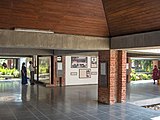
Gandhi Sangrahlay – Inside Corridors
-

Gandhi Sangrahlay – Outside
-
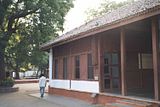
Front View of Mahatma Gandhi‘s House
-
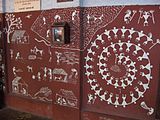
Warli Art at Sabarmati Ashram
-

Warli Art at Sabarmati Ashram
-

God is Truth, Circa 1927
-

Beautiful View from the door of Gandhi’s house


See also
References
- ^ Gandhi, Mohandas. “Gandhi Ashram Official Website”.
External links
 Media related to Sabarmati Ashram at Wikimedia Commons
Leave a Reply
You must be logged in to post a comment.