Chad: Children Dancing for Peace
This is a wonderful song posted by European Union Humanitarian Aid and Civil Protection
These are the voices of the EU Children of Peace in 2014, the children are from Chad.
Below is information from the UNHCR, Chad is being impacted from conflict in surrounding Central African Republic, South Sudan, Nigeria, Chadian returnees at risk of statelessness. Violence is a global issue that ripples out and impacts the consciousness of the entire planet. So when we look and say ‘not our problem’, perhaps we can look and wonder ‘what are the voices for peace?’. We have to learn to work towards what we want, not what we don’t want. We can create the future by imagining the way we want it and staying focused, feeling it and really working towards it. All violence is a call for help, people are angry, they are hurt, they are insecure and so it goes. They do not know of another way, let’s help them find another way that serves them.
Refer http://www.unhcr.org/pages/49e45c226.html
Working environment
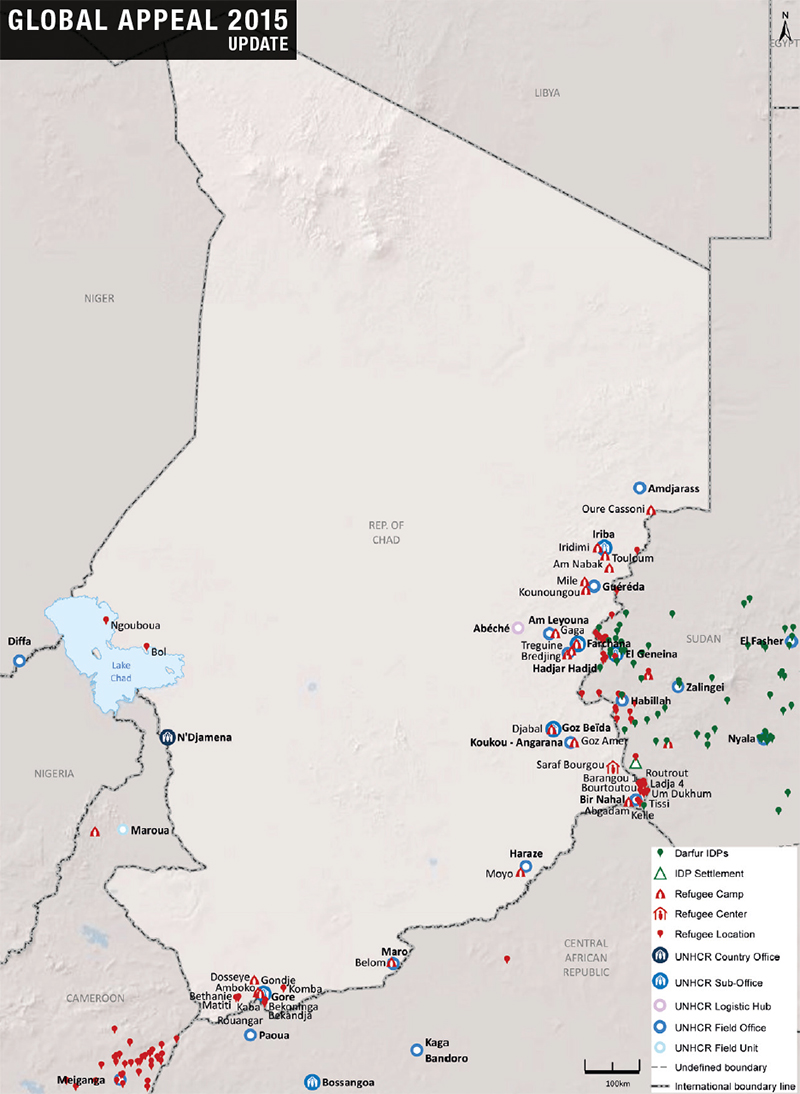
-
With ongoing conflict and violence in several neighbouring countries, notably the Central African Republic (CAR), Nigeria and South Sudan, Chad’s refugee population is likely to increase in 2015.
-
The needs of CAR refugees for protection and assistance will remain significant in 2015.
-
UNHCR enjoys excellent working relations with the Chadian Government. The organization will continue to assist the Government in issuing national identity cards to second and third-generation Chadian returnees without family links, who are at risk of statelessness.
-
On 31 July, more than 1,000 Nigerian asylum-seekers arrived on the island of Choua in the Lake Chad region, some 4 kilometres from the border crossing. Chad was already hosting more than 1,500 Nigerian refugees (488 families). A supplementary appeal was launched to cover the cost of responding to these new emergency needs. Given the unpredictability of incidents and violence in Nigeria, UNHCR is planning for further influxes in 2015.
-
The Government has granted refugees and returnees access to arable land for agricultural production, contributing to their self-reliance, as well as social and economic integration strategies. The Government is supporting efforts to seek alternatives to camps, allowing refugees to settle in host communities and access basic community services.
People of concern
In 2015, the main groups of people of concern to UNHCR will be refugees, mainly from Sudan and from the Central African Republic (CAR), as well as more than 1,600 Nigerian refugees. They live in camps, within communities, sites within villages/districts, and urban areas. Also of concern are a group of evacuees from the violence in the CAR: while they were born in the CAR of Chadian parents – some of whom were also born in the CAR – they have no remaining links with Chad and are at risk of statelessness.
| UNHCR 2015 planning figures for Chad | |||||
|---|---|---|---|---|---|
| Type of population | Origin | January 2015 | December 2015 | ||
| Total in country | Of whom assisted by UNHCR |
Total in country | Of whom assisted by UNHCR |
||
| Total | 526,140 | 500,780 | 505,370 | 479,230 | |
| Refugees | Central African Rep. | 97,550 | 86,920 | 100,000 | 96,000 |
| Sudan | 368,290 | 353,560 | 377,480 | 355,330 | |
| Various | 3,000 | 3,000 | 5,500 | 5,500 | |
| Asylum-seekers | Dem. Rep. of the Congo | 130 | 130 | 140 | 140 |
| Sudan | 20 | 20 | 20 | 20 | |
| Various | 110 | 110 | 130 | 130 | |
| Returnee arrivals during year (ex-refugees) | Chad | 1,000 | 1,000 | 2,000 | 2,000 |
| Stateless | Stateless | 50 | 50 | 100 | 100 |
| Others of concern | Various | 56,000 | 56,000 | 20,000 | 20,000 |
| Response |
Needs and strategies
In 2015, UNHCR will continue to provide basic services, such as nutrition, health, WASH, education, and documentation, to refugees and other people of concern; and work with all partners to place protection considerations at the core of all interventions.
Facilitating livelihood activities, finding alternatives to camps, acquiring land and promoting freedom of movement will remain key priorities in a bid to strengthen self-reliance. UNHCR will work with the Government and development partners to progressively integrate refugees into existing programmes and other relevant initiatives. Non-agricultural livelihoods are limited, with only 2 per cent of refugees expected to access micro-finance services by the end of 2015.
Education, sexual and gender-based violence (SGBV), and child protection will be priorities. As part of a multi-year strategy, the organization will establish measures to: identify and monitor children at risk; carry out best interest determination; provide support and quality services to SGBV survivors; prevent exploitation and violence, especially for refugee girls; and ensure the smooth transition from the Sudanese to the Chadian curriculum. Funding shortfalls mean support for access to secondary schools and vocational training will be limited, with only half of the targeted secondary-age population in school. To support SGBV survivors, UNHCR will implement safety and security measures, provide material assistance, build local support capacity, and run awareness-raising activities.
The conflict in the CAR and ongoing intra-community clashes in Darfur make voluntary repatriation in 2015 unlikely. With limited prospects for local integration, resettlement remains the only viable durable solution. UNHCR will prepare refugees for durable solutions by facilitating livelihood opportunities, strengthening self-reliance and promoting peaceful coexistence with local communities. It will also support efforts to bridge the gap in living standards between refugees and host communities. Alternatives to camps will be explored, and all efforts made to facilitate refugees’ freedom of movement.
Existing national structures, such as water, sanitation and hygiene facilities, health centres and schools, will be strengthened, and relevant line ministries’ capacity to run and maintain such services will be enhanced. Important partnerships with development actors and links to national development plans will be nurtured, to increase the sustainability of interventions.
The option for new refugees to stay in communities instead of camps will be pursued. UNHCR will provide technical expertise to support the Government in complying with international commitments.
The Office will work to remove barriers to accessing documentation for some 113,000 Chadian returnees. It will also endeavour to uphold good quality registration, and provide identification cards to all refugees, gradually introducing biometrics in the course of 2015. In addition, as a new law on civil status was adopted in 2013, it is likely that by 2017, birth certificates will be automatically issued to refugee children in eastern Chad, and the backlog of Sudanese refugees without documents will be addressed.
UNHCR will assist the authorities in issuing identification documents to Chadian returnees to prevent them becoming stateless. Some 36,000 Chadians without links will have been documented by the end of 2014, and another 20,000 in 2015.