The Healing Power of HeART, La Trobe University
I found this article quite literally by chance. I found a university on my blog in the UK and it lead me to this program.
The arts can be infathonable to those of a rational perspective, many misinterpret artists they may consider them rebellious, radical or out there. It is because when you are open to ideas you will allow any ideas to come, you don’t filter or rationalise or debunk, you just express as you tap into possibilities without an agenda. The mind of the artist is very free. Others believe the arts are recreational, they are there for relaxation after a hard day at the office, or a trip to the theatre or art gallery to break out of mindsets that many feel trapped in. The arts in truth is the very essence of the human spirit, it enables insights into who we really are, when we stop thinking. Thought has its purpose and if it can be used in tandem with the arts then intellegence can be expanded. When I was a researcher I did quantitative research but I found when I designed research with qualitative (exploratory) and put on my investigative hat, I was able to discover far more than just relying on numbers to guide percpetions of reality or what is going on. I don’t ignore flights of fancy, I embrace radical ideas that may crystalise overtime. I have an ability to suspend judgement and just allow things until I gain real insights into whatever I am exploring. Overtime I have learned to trust myself with my intuition. Where I would differ from other analysts is that ‘love and truth ‘ guides my work. Even as an analyst I would report back word for word exactly what was said to ensure integrity as I honoured the client and the respondent. I wanted to be a bridge to enable understanding. If I thought research was not in integrity, that is, the subject matter was not of benefit to society, then I would not go ahead with the study. I realised if I lend my energy to furthering pursuits that cause harm then I become part of the problem not the solution. That is the artist in me that connects me to the whole. I am responsible for what I do and how it impacts the whole. I see that clearly as I feel the connection.
To open up minds is to open the heart and you will note that heART has art in it. It has ‘he’ as well. As an artist I find that interesting, maybe when he finds his heart, he sees the art even in the day to day life. Art and heart is another form of intelligence. In truth it opens you to higher intelligence, that all people can access, when they access the right brain. Women are amenable to this as they tap into emotions readily and are typically not shut down by society. This means the neurological mapping is enhanced in parts of the brain that wire for creativity. Therefore, you see differently. This is the diversity that some can call non-conformity but in truth it is seeing differently, those who can’t understand it have to label it rather than learn from it with an open mind.
The article below speaks of how the arts are used with psychological and social illness. In my experience poetry became the modus operandi of healing as I was able to express my truth and find answers through creativity. What it actually did was open up a capability of being able to see what was not visible, this is not imagining this is in-sight. In retrospect I knew my instincts were right. My desire for truth was so strong as the pain was so great that I had to find answers. I was forced by circumstances to access insight. I became used to going to stillness as I waited for inspiration to guide me back to the harmony, I opened my mind and did not block the flow. When I experienced trauma which was a result of suppression and others negativity, I felt intuitively to write poetry as I had to find a way out of the pain I felt to discover the beauty that felt more real to me. Art in its many forms allows expression, communication and self-discovery as described in the article below. So in many respects life’s challenges can provide a channel to higher truth if you desire to transform negative situations into a search for truth. Otherwise people may sink into mental illness or give up and suicide.
Humanities are crucial in our world, it is not the breeding ground for activism as some perceive, it is the creative spaces that open up inquiry using emotional intelligence and human creativity. Contrasting viewpoints are the central reason universities exist and critique must be embraced with curiosity if we are to expand knowledge and understanding to truly make a difference in this world.
I would love to see universities not only offer programs like this but use this valuable information in the university community so that all benefit from the knowledge. There tends to be silos of knowledge that are segmented, lecturers go and lecture about it but the university community itself do not know about it or use these findings in their own work. I think that would be very beneficial as it could be part of conflict resolution processes that require therapeutic interventions.
To foster enviroments where people speak up with respect but bravely offering alternative views in a context where there is no hidden agenda but to truly exhibit freedom of speech not as a threat but illumination. This is a core principle of democracy. I deeply believe in this as I know as a research analyst that when we embrace all views common sense will surface.
I learn from every person I meet because my mind is open to infinite possibilities, all ways. I feel to write a poem now to allow life to express through me.
Art is the heART of Freedom
Is art a therapy?
Or is it sanity in search of life’s artistic portrayal,
For life is like a portrait gallery,
So many pictures in frames,
Frame by frame we move past life to the future,
Images like flash cards as we seek to rationalise,
We instinctively search for meaning,
For the artistic impression is the expression of freedom,
That even the frame cannot contain,
Imagination has no bars, no judgements, no criticism,
As it travels beyond the quill, the pencil, the brush or chisel to find its medium is unique,
As we look beyond the negative space to see the outline 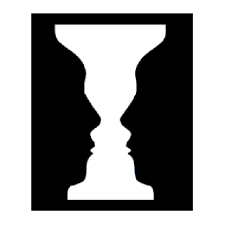 is a vase
and two faces
reflecting each other,
For both are right,
As right and wrong disappears into the void
of higher awareness
As we adjust the lens,
the lighting, the colours, the technique changes the big picture,
For we can see then create the future,
As infinite possibilities call us home to who we are,
This is the unbridled passion that is not a fashion statement,
Or seeking to be seen to be,
This is a country untamed, wild and free,
This is the primoridal impulse of potential,
That feels for the pulse of life without credentials,
Impulse is not unruly it is courage that acts from feeling before thinking,
Testing the boundary before containing in corrals of siloed structures,
To transcend what is believed and then seen,
To know each is the creator of their reality,
For truth is the therapy that heals all dischord,
As freedom is the harmony of life remembered,
As each member comes together to sing in harmony,
Placing the horse before the cart,
For this is the heART of
freedom.
https://www.latrobe.edu.au/news/articles/2008/article/art-therapists-concentrate-the-healing-power-of-art
Art therapists concentrate the healing power of art
Why do humans make art?
Many artists don’t really know why they do what they do, but some understand better than most the unseen forces at work in human creativity.
They are the therapeutic healers who work through the creative power of the arts to heal deep lacerations to the human psyche inflicted by trauma, better known as Art Therapists.
While they constitute a relatively new profession, Art Therapists are increasingly recognised in Australia, New Zealand, the US and the UK for their interventionist capabilities in dealing with social and psychological illness.
They work across diverse levels and institutions in the community from schools, prisons, aged care and homeless facilities, to psychiatric wards, hospitals and hospices to heal and rehabilitate people traumatised by social, mental or psychic injuries – through the deeply liberating power of art.
Today (Friday August 8) at La Trobe University’s Melbourne City campus up to 50 practitioners of this still emerging discipline will meet to workshop their creative insights – under the supervision of the international doyen of their kind, Associate Professor Andrea (Andy) Gilroy, Associate Professor of Art Psychotherapy at Goldsmith’s College, University of London.
It will be the biggest gathering of practising art therapists ever assembled in one place in Melbourne – in recognition of the reputation of their mentor, who is recognised internationally as a leading figure and educator in the art therapy field.
Dr Gilroy is visiting Australia to give lectures and workshops at the three Australian universities currently graduating Master’s level Art Therapists – La Trobe University in Melbourne, the University of Western Sydney, and the University of Queensland.
After lecturing to Graduate Diploma and Master of Art Therapy students at La Trobe’s Bundoora campus yesterday August 7), Dr Gilroy will lead Victorian practitioners today in discussions and workshops exploring ways of thinking visually about their research.
Explaining the principles behind art therapy, Dr Gilroy said:
“Art therapy is a relatively new, effective and rather radical intervention that is gradually gaining recognition in the health, social, educational and criminal justice systems in Australia. The process enables people to focus on expression, communication and self-discovery through making images in the context of a therapeutic relationship with an art therapist.”
Art therapy education had been operating in Australia since the early 1990s, providing education and training at Master’s level, Dr Gilroy said. With Awards now established in the health systems of New South Wales and Western Australia, the profession was gradually gaining the recognition it deserved.
Dr Gilroy is available for interviews. Biography below.
Links
- https://www.latrobe.edu.au/publichealth/departments/counselling_and_psych_health.htm
- https://www.latrobe.edu.au/publichealth/ArtTherapy/index.htm
Picture opportunity
Professor Gilroy leads up to 50 practising art therapists workshopping their art-based healing practices. 2pm to 2.30 pm, Friday August 8, Lecture Theatre G 04, La Trobe University City Campus, 215 Franklin Street, Melbourne.
Biography
Associate Professor Andrea (Andy) Gilroy
Associate Professor Andrea Gilroy is Associate Professor of Art Psychotherapy at Goldsmiths’ College, University of London, where she has worked for more than twenty years. She is one of the key figures in international art therapy and has been involved with the development of art therapy in Australia through her work as an educator and researcher at the University of Western Sydney. She is an experienced educator and researcher whose research interests include the interface between theories and practices of visual art/visual culture and art therapy and the development of art therapy’s evidence base. Her article ‘On occasionally being able to paint’ in the International Journal of Art Therapy, Volume 9, Issue 2 April 2004 , examined the importance of maintaining our personal artwork alongside therapy practice, widely accepted as a valuable part of a balanced approach to art therapy.
Another recent article ‘Taking a long look at Art: Reflections on the context of production and consumption of art in Art Therapy’ examines the way she looked at and responded to the frescoes in Italy and London. She says the art made in art therapy is profoundly influenced by its social context and the environment of its production, and conditioned by the social and professional contexts in which we look and are looked at. Her books include ‘Art Therapy, Research and Evidence-based Practice’, and ‘Art and Music: Therapy and Research.’ She co-authored ‘The Changing Shape of Art Therapy: New Developments in Theory and Practice,’ ‘Pictures at an Exhibition: Selected Essays on Art and Art Therapy,’ and ‘Art Therapy: A Handbook’ (Psychotherapy Handbooks Series)
In her most recent publication ‘Art Therapy, Research and Evidence-Based Practice’ (2006, Sage Publications) she challenged the idea that quantitative research should be the dominant paradigm for research in the arts therapies. She acknowledged that in an age of dwindling resources, evaluating the efficacy of practice is important in order to give the best possible care to patients. This book makes a major contribution to the field of art therapy by reviewing, in an accessible and informed manner, the issues around the development of research-informed practice. The author offers an overview of different traditions of inquiry that will be of value to practitioners as well as those actually involved in carrying out research. (Art Therapy around the world is under increasing pressure to become more “evidence-based”. As a result, practitioners now need to get to grips with what constitutes “evidence”, how to apply research in appropriate ways and also how to contribute to the body of evidence through their own research and other related activities.
Interview requests
Associate Professor Lawrie Moloney
Head, Department of Counselling and Psychological Health
School of Public Health
La Trobe University, Bundoora
T: 03 9479 2578
M: 0448 383 003
E: l.moloney@latrobe.edu.au