Control Orders or Democratic Rights and Due Process?
What happens in the scenario that Ministers are funded by corporations or individuals or are operating in their own interests not the public’s interest? What happens to those they deem as a threat? That threat may have nothing to do with terrorism fears but the fear of voices that may critique in the name of democracy policies or edicts that they believe are not in the public interest. I recall years ago Scott Parkin was a US citizen who protested Halliburton, the oil company which Dick Cheney was the CEO. This company had contracts in Iraq approved by the government at the time within which he was the Vice President. His background has highlighted many abuses of power including the illegal war of aggression in Iraq as cited by Scott Ritter the former Senior Weapons Inspector and CIA operative. I recall in Australia at this time, John Howard was in power he resurrected the 1911 Sedition laws (speaking out against the government) and under the ASIO Act had the power to hold people without being placed before a judge for 14 days. This is concerning as it moves us away from judicial oversight and rights. We start to look like a dictatorial state which is not in the interests of the public as people can be taken in the middle of the night. In this period of time now we have a window to ensure we do not lose the rights and freedoms of a healthy democracy. Scott Ludlum in the previous blog is raising the issue of rising authoritarianism, I concur. Moreover, what this really is is the model of business imposed on governance. This has been a mistake that has implications for democracy. Solutions to these problems would ensure community oversight of government. There would have to be some way to ensure openness and visibility in the public interest.
https://www.theguardian.com/australia-news/2018/feb/28/number-of-ministers-able-to-approve-terrorism-control-orders-doubles
Number of ministers able to approve terrorism control orders doubles
In Dutton’s Home Affairs, even the assistant minister can order terrorism control orders
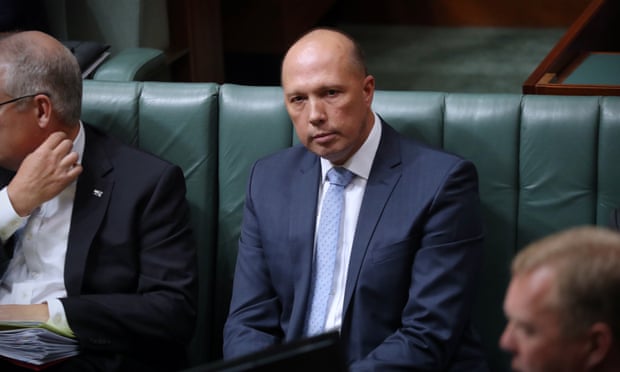
Before Dutton’s mega-department the attorney general was responsible for authorising control orders. Photograph: Mike Bowers for the Guardian
The creation of Peter Dutton’s Department of Home Affairs has doubled the number of ministers who can approve terrorism control orders to four and given the power for the first time to an assistant minister, Alex Hawke.
The Attorney General’s Department revealed the expansion of ministers who can approve orders for people to be subject to house arrest and personal surveillance at Senate estimates on Tuesday evening.
The ministers who can now approve the orders are: the home affairs minister, Peter Dutton; the assistant minister for home affairs, Alex Hawke; the minister for citizenship and multicultural affairs, Alan Tudge; and the minister for law enforcement and cybersecurity, Angus Taylor.
Labor’s shadow attorney general, Mark Dreyfus, has warned the revelation shows the creation of the Department of Home Affairs has watered down checks and balances in counter-terrorism legislation and there is no clear basis for the ministers to exercise the authority.
Control orders can stop people leaving Australia, communicating with certain people, accessing technology and force them to remain at a specified premises for a maximum of 12 hours within a 24-hour period, wear a tracking device, and report to a police station.
Before the creation of Dutton’s mega-department the attorney general was responsible for authorising control orders, and the justice minister also had the power.
On Tuesday, Sarah Chidgey, the first assistant secretary of the Attorney General’s Department, told estimates that authorising one minister “authorises all ministers in the portfolio to exercise that power”.
She confirmed it was the first time an assistant minister could approve control orders.
The assistant minister for science, jobs and innovation, Zed Seselja, said that Hawke had been “switched over” to the home affairs department and “wouldn’t have had the powers before”.
Dreyfus told Guardian Australia: “Malcolm Turnbull has handed over control of the Department of Home Affairs to Peter Dutton, who has given three junior ministers, none of whom sit on the National Security Committee, the power to authorise counter-terrorism measures under the criminal code.”
“These orders restrict the liberty of Australian citizens and, while a necessary tool to combat terrorism in specific circumstances, have only ever been issued by the attorney general in highly sensitive situations,” he said.
“It is wrong that a junior minister like the minister for citizenship and multicultural affairs, who has no responsibility for these national security issues, should be given this significant power merely as a consequence of departmental restructuring.”
Dreyfus said Labor supported “strong measures to combat terrorism” and had worked constructively to make national security legislation “more fit for purpose”.
“In his inept haste to appease the right wing of the Liberal party, however, Mr Turnbull should not erode the important checks and balances in our national security system by downgrading approvals for sensitive counter-terrorism measures to junior ministers.”
The New South Wales Council for Civil Liberties opposes control orders but its president, Stephen Blanks, said if the state is to have such a power to detain people it “should be in the hands of the senior law officer, the attorney general”.
“It is unsatisfactory for the power to approve this order to be in hands of junior ministers or even senior minister like Peter Dutton, who is not a lawyer,” he said.